The year on one page
| Months | Rain normal at Suwanee 1.5 W, inches | Other note from NOAA or the National Weather Service |
|---|---|---|
| January and February | 4.84 and 4.73 | Cumming 2 N: 19.0 and 14.4 freeze days (low of 32 or colder) |
| March | 5.07, the wettest month | 8.5 freeze days; tornado days cluster March to May |
| April and May | 3.97 and 4.34 | Damaging winds average 19 days a year across the warning area |
| June to August | 4.99, 4.68 and 4.67 | Buford 2.8 SSE records 6.19 in July |
| September and October | 4.18 and 3.82 | September 2009: Suwanee Creek crest of 14.30 feet |
| November and December | 4.49 and 4.73 | Cumming 2 N: 8.2 and 15.2 freeze days |
January and February: freezing nights and long rains
The 1991-2020 normals from NOAA's Suwanee 1.5 W gauge give 4.84 inches in January and 4.73 in February. At Cumming 2 N, a long-record station north of Suwanee, a low of 32 degrees or colder turns up on 19.0 days in January and 14.4 in February.
That pairing is what Gwinnett County's freezing-weather page is about: cracked pipes can release hundreds of gallons a day, and the page shows how to close the valve at the meter. Garages, crawl spaces and exterior walls take the cold first.
March: the wettest month, with the first storms
March is the wettest month at the Suwanee 1.5 W gauge, at 5.07 inches, and the Johns Creek 3.0 SSW gauge is within a tenth at 5.05. Peachtree City's National Weather Service office puts tornado days mostly between March and May.
Wet ground and storms arrive together while the freezes have not quite left: Cumming 2 N still counts 8.5 days at or below 32 degrees. Roofs, gutters and drains get their hardest test of the year.
April and May: storm days, lighter rain
April's normal is 3.97 inches and May's 4.34 at Suwanee 1.5 W, lower than March but still wet. The National Weather Service says damaging thunderstorm winds average 19 days a year across its warning area and large hail 7 days, so a month with less rain can still bring wind-driven leaks.
Georgia Power's outage page lists 1-888-891-0938 for a downed line, with 911 as the other route.
June through August: downpours and sticky air
Suwanee 1.5 W normals run 4.99 inches in June, 4.68 in July and 4.67 in August. The Buford 2.8 SSE gauge east of town records 6.19 inches in July. Heavy single-day rain is routine: at Cumming 2 N, days with at least an inch run between 1.3 and 1.5 a month through the summer.
Sticky air matters indoors too. The EPA's brief guide would like indoor air kept under 60 percent humidity, ideally between 30 and 50 percent.
September and October: one flood to remember, then the driest weeks
Suwanee 1.5 W gives 4.18 inches in September and 3.82 in October, the driest month. September 2009 shows what the month can do: rain began on the 15th, the Atlanta airport had 3.70 inches by 8 p.m. on the 19th, and Suwanee Creek crested at 14.30 feet on the 21st against a flood stage of 8.
Some 20,000 buildings had major damage in that event, per the National Weather Service's write-up, and 17 Georgia counties received federal disaster declarations.
November and December: the first hard freezes return
Suwanee 1.5 W gives 4.49 inches in November and 4.73 in December. At Cumming 2 N a low at or below 32 degrees comes on 8.2 days in November and 15.2 in December, and the season's first freezes find pipes that went untested all summer.
Before the cold, Gwinnett's page says where the meter valve is and how to close it, and the leak page's two-hour test is a way to check that nothing is already weeping.
When does a seasonal sign deserve a call?
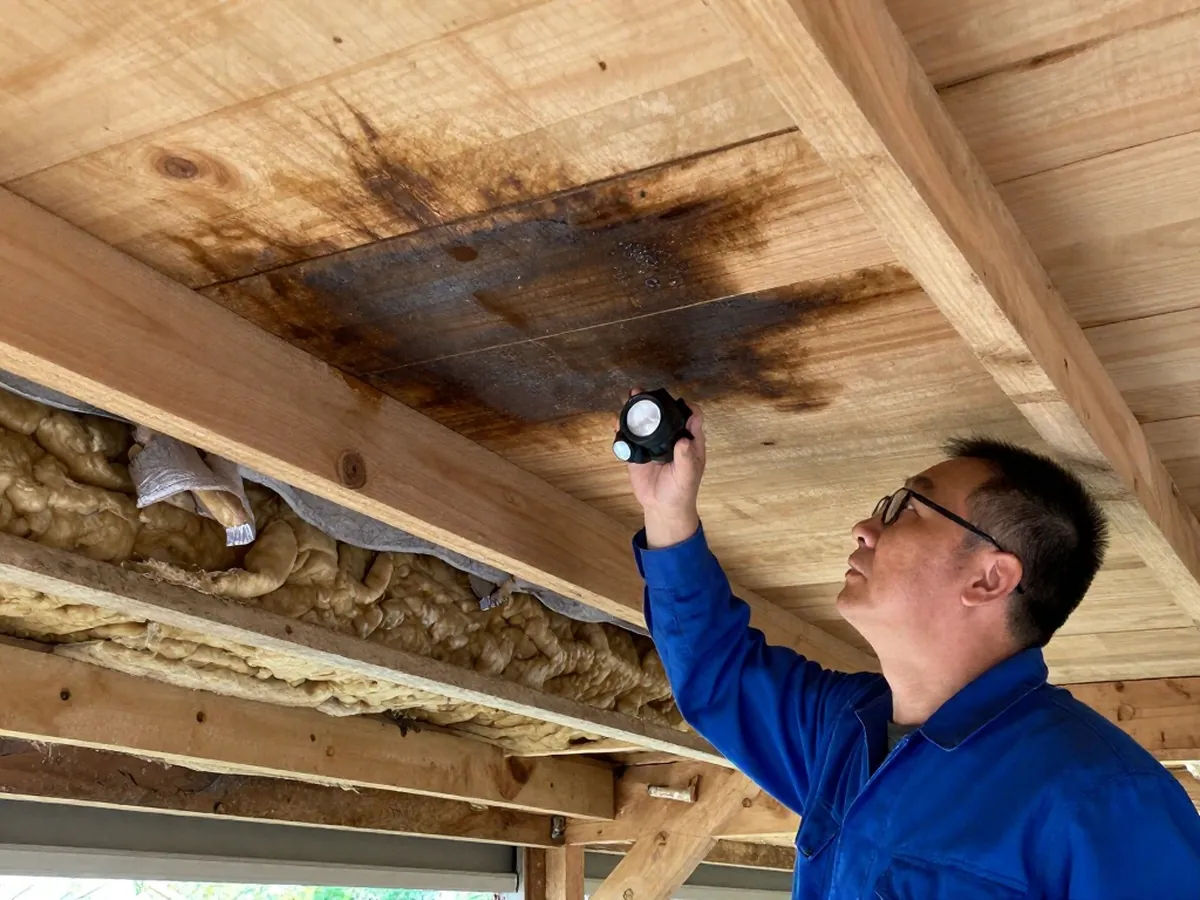
A drip under a ceiling after a March storm and a split pipe after a January freeze point to different jobs: storm and roof leak damage for the first, burst pipe water damage for the second.
Call (678) 572-1407 and give the month, the weather and what is wet. The contractor can arrange a visit.
Where this comes from
- NOAA NCEI, 1991-2020 monthly normals, Suwanee 1.5 W (US1GAGW0008)
- NOAA NCEI, 1991-2020 monthly normals, Buford 2.8 SSE (US1GAGW0040)
- NOAA NCEI, 1991-2020 monthly normals, Johns Creek 3.0 SSW (US1GAFT0010)
- NOAA NCEI, 1991-2020 monthly normals, Cumming 2 N (USC00092408)
- National Weather Service Peachtree City, The epic floods of September 2009
- National Weather Service Peachtree City, Severe weather climatology
- National Weather Service Peachtree City, Flooding
- National Weather Service, Flood safety
- National Weather Service, Turn around, don't drown
- Gwinnett County Water Resources, Freezing weather
- Gwinnett County Water Resources, Leak detection
- U.S. EPA, A brief guide to mold, moisture and your home
- Georgia Power, Outages and downed power lines
Checked 1 Nov 2026